
 By gamerforge57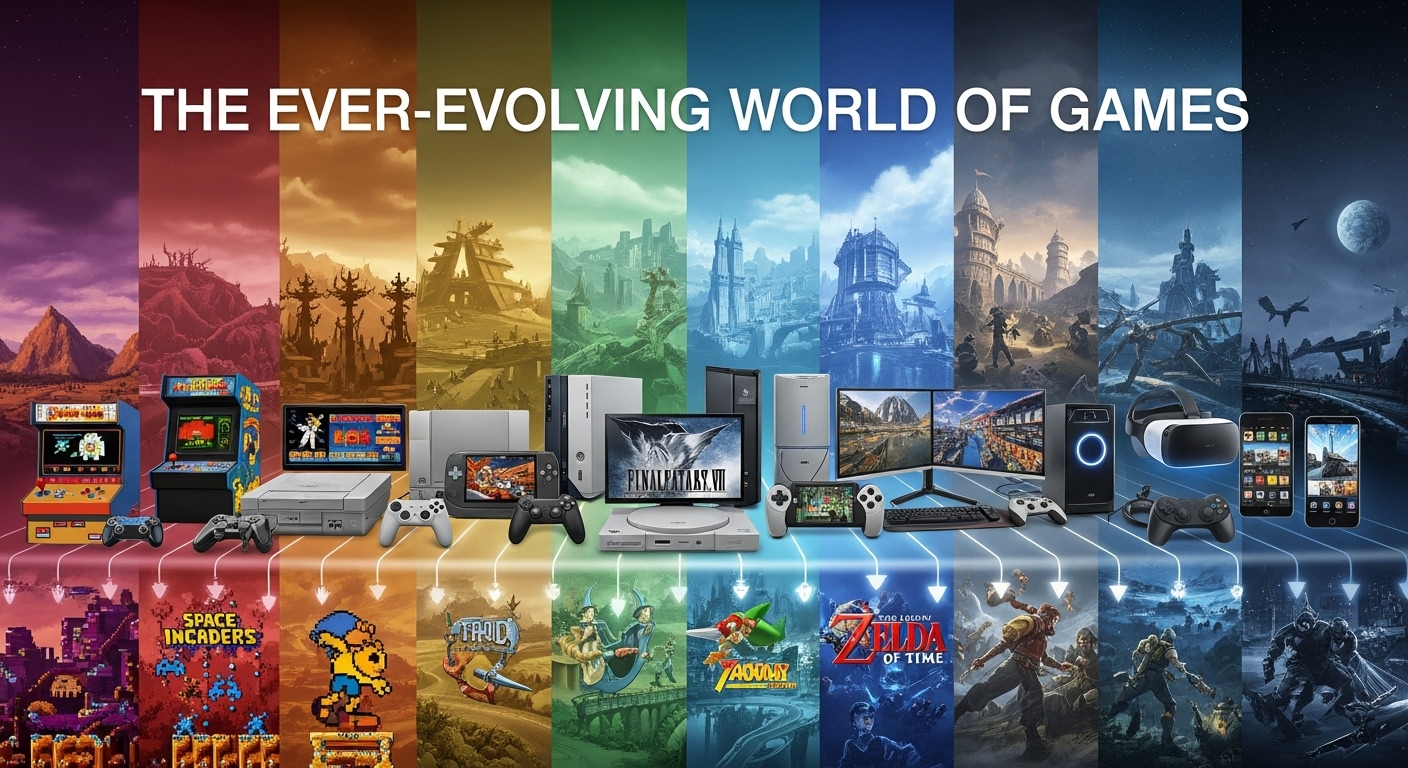
Introduction to the Universe of Games
Games have always been an inseparable part of human life. From ancient civilizations carving dice out of stone to modern gamers battling in vast online worlds, the concept of play has evolved, adapted, and transformed alongside humanity. Games serve as a mirror to human creativity, imagination, competition, and community. They are not merely a form of entertainment but a vital cultural expression. Whether played on a dusty village ground, on a chessboard, or through the glowing screen of a computer, games shape minds, nurture strategy, and connect generations.
The fascinating aspect of games lies in their universality. Every culture on Earth has its own form of play, from children’s make-believe adventures to complex adult sports and digital simulations. The drive to play is almost instinctive, a built-in feature of human behavior that transcends language, geography, and time.
The Ancient Origins of Play
The roots of gaming reach far deeper into history than many imagine. Archaeological discoveries show that games existed in almost every ancient civilization. The ancient Egyptians played a board game called Senet, which dates back more than five thousand years. In Mesopotamia, people played the Royal Game of Ur, while ancient China developed Go, one of the most strategically profound games in history. These games were not simply leisure activities but often held symbolic or spiritual meanings.
For instance, Senet was believed to represent the journey of the soul through the afterlife, turning a pastime into a metaphysical exploration. Similarly, Go, with its simple rules but deep strategic complexity, became a philosophical expression of balance and harmony. Games in ancient times were as much about understanding life and fate as they were about fun.
Sports, too, have ancient origins. Wrestling, running, and archery can be traced back to prehistoric rituals and survival skills. The ancient Olympic Games of Greece formalized physical contests into organized competitions that celebrated human strength, agility, and honor. This early fusion of play and performance laid the groundwork for the modern sports and gaming culture that thrives today.
The Evolution of Board and Card Games
As civilizations developed, so did their games. Board games continued to evolve through centuries, adapting to social, cultural, and technological changes. Chess, for example, originated in India as Chaturanga before spreading to Persia and later Europe, where it became a symbol of intellect and strategy. It is fascinating that a game invented over a millennium ago still thrives today, now played both on wooden boards and digital platforms.
Card games emerged during the Tang dynasty in China, later spreading through trade routes to the Middle East and Europe. Games like Poker and Blackjack have since become global phenomena, combining chance, skill, and psychological tactics. Each deck of cards carries with it a legacy of culture and creativity.
Board games flourished in the 19th and 20th centuries as leisure became more accessible to the middle class. Titles like Monopoly, Scrabble, and Clue turned into family traditions, often teaching economic thinking, vocabulary, or deduction in playful ways. The tactile feeling of rolling dice, moving pieces, and watching a plan unfold remains irreplaceable, even in a world increasingly dominated by screens.
The Birth of Video Games
The true revolution in gaming began in the 20th century with the advent of digital technology. The earliest video games appeared in research labs during the 1950s and 1960s, often created by scientists experimenting with computers. Games like “Tennis for Two” and “Spacewar!” were primitive but groundbreaking. They proved that computers could be not only tools for calculation but also platforms for play.
The 1970s saw the commercial explosion of video games with arcade hits like “Pong” and “Space Invaders.” Suddenly, people could experience interactive entertainment in public spaces, feeding coins into machines that brought light, sound, and excitement to life. The home console era soon followed, with systems like the Atari 2600 making games accessible in living rooms worldwide.
By the 1980s and 1990s, the gaming industry became a cultural force. Iconic titles such as “Super Mario Bros.,” “The Legend of Zelda,” and “Sonic the Hedgehog” shaped the childhoods of millions. Developers began to focus not just on gameplay mechanics but also on storytelling, art, and music. A game was no longer a mere diversion; it became an experience.
The Rise of 3D Worlds and Immersive Play
The leap from 2D to 3D in the mid-1990s transformed gaming into something entirely new. Players could now move freely in three-dimensional spaces, exploring vast environments that felt alive. Games like “Tomb Raider,” “Final Fantasy VII,” and “The Legend of Zelda: Ocarina of Time” set new benchmarks for immersion and narrative depth.
Technology advanced rapidly, bringing better graphics, sound design, and artificial intelligence. As consoles and computers grew more powerful, developers could create more detailed worlds, more realistic physics, and more complex characters. The line between reality and imagination began to blur.
In the early 2000s, online multiplayer gaming became a phenomenon. Titles like “World of Warcraft” and “Counter-Strike” connected millions of players across the globe, forming digital communities that transcended borders. Gaming was no longer a solitary or local activity; it became social, collaborative, and competitive on a global scale.
The Era of Mobile and Casual Gaming
When smartphones entered the scene, gaming underwent yet another transformation. Suddenly, everyone became a potential gamer. Mobile games like “Angry Birds,” “Candy Crush,” and “Clash of Clans” reached audiences far beyond traditional gaming demographics. The simplicity of mobile interfaces and the accessibility of app stores allowed games to reach billions of people.
This democratization of gaming changed industry economics and culture. Developers no longer needed massive budgets to create successful titles. Small indie teams could craft creative experiences that resonated with millions. Mobile gaming also introduced new business models like free-to-play systems supported by in-game purchases. While controversial, these models reshaped how games are funded and maintained.
The Power of Storytelling in Games
One of the most profound developments in modern gaming is the rise of narrative-driven experiences. Today’s games can rival films and novels in emotional depth and storytelling sophistication. Titles like “The Last of Us,” “Red Dead Redemption 2,” and “Life is Strange” demonstrate that games can tell powerful human stories that make players laugh, cry, and reflect.
Unlike traditional media, games give players agency. The ability to make choices, face consequences, and shape outcomes creates a personal connection between player and narrative. This interactivity is what makes gaming a unique art form. It turns storytelling from passive observation into active participation.
The emotional power of games also challenges outdated stereotypes. Once dismissed as shallow entertainment for children, games now explore mature themes like morality, identity, trauma, and loss. They have become legitimate mediums of expression, capable of social commentary and artistic innovation.
The Competitive Spirit: Esports and Professional Gaming
Competition has always been at the heart of play, but the rise of esports has elevated it to unprecedented levels. What began as friendly matches between friends has evolved into a multibillion-dollar industry. Professional gamers train like athletes, mastering reflexes, strategies, and teamwork.
Games like “League of Legends,” “Dota 2,” and “Counter-Strike: Global Offensive” attract audiences comparable to traditional sports events. Millions of fans watch live tournaments, cheer for their favorite teams, and follow players like celebrities. Esports has redefined what it means to be an athlete in the digital age.
This competitive scene has also fostered a new ecosystem of content creation. Streamers and YouTubers build communities around gameplay, commentary, and entertainment. Platforms for live streaming have turned gaming into a social spectacle where players share experiences, knowledge, and humor.
The Art and Science of Game Design
Behind every great game lies an intricate blend of art, psychology, and technology. Game design is a discipline that combines storytelling, visual design, user experience, and mathematical balance. The best games are those that seamlessly merge mechanics and meaning.
Designers study how players think and feel. They craft challenges that are neither too easy nor too hard, pacing that keeps engagement alive, and worlds that feel alive with possibility. Every sound effect, texture, and animation is carefully considered. A game is a living ecosystem where every element serves a purpose.
Technology has enabled unprecedented creative freedom. Game engines like Unity and Unreal allow even small studios to build breathtaking worlds. Virtual reality and augmented reality are expanding the boundaries of what games can be, turning living rooms into interactive playgrounds and fantasies into tangible experiences.
The Social Dimension of Gaming
Games are often portrayed as solitary, but in reality, they are profoundly social. From the earliest board games played among families to today’s online multiplayer communities, games have always fostered connection. Players share strategies, form friendships, and even build professional relationships through gaming.
Online gaming communities have become global gathering places. Guilds, clans, and teams give players a sense of belonging and identity. For many, gaming is not just a pastime but a social lifeline—a way to connect with others across distance and culture.
Games have also been used for education, therapy, and social activism. Educational games teach complex subjects through interactive learning, while therapeutic games help people manage anxiety, trauma, or cognitive challenges. Play can heal as much as it entertains.
The Role of Games in Culture and Society
Gaming is not isolated from the world; it reflects and influences it. Video games today tackle real-world issues such as climate change, politics, mental health, and social inequality. They allow players to explore moral dilemmas, experience other perspectives, and engage with difficult subjects in a safe, interactive environment.
The artistry of games also contributes to broader cultural conversations. Museums now exhibit video game design, universities offer degrees in game studies, and critics analyze them as seriously as literature or cinema. The recognition of gaming as an art form marks a cultural milestone.
Moreover, gaming has become a shared language among generations. Parents and children often play together, creating memories that blend old and new forms of play. From grandparents playing digital card games to teenagers creating their own virtual worlds, games continue to unite people across age and experience.
The Future of Games: Beyond Reality
Looking ahead, the future of games promises even more astonishing possibilities. With the rise of artificial intelligence, virtual reality, and augmented reality, the boundaries of gaming are expanding into entirely new dimensions. AI-driven worlds can adapt to player behavior, creating personalized narratives that evolve dynamically.
Virtual reality brings full immersion, allowing players to physically step into new worlds. The sense of presence and embodiment in VR games changes how people perceive play. Augmented reality, on the other hand, blends digital experiences with the physical world, turning streets, parks, and homes into interactive spaces.
Cloud gaming and streaming technologies are breaking down hardware barriers, making high-quality gaming accessible on any device. This democratization could make gaming even more universal, connecting billions in shared experiences.
The Psychological Impact of Games
Games are more than entertainment; they have profound psychological effects. They stimulate problem-solving, creativity, and resilience. Cooperative games teach teamwork, while strategic ones enhance planning and foresight. Even fast-paced action games can improve reflexes and decision-making.
However, like all powerful tools, games require balance. Excessive play can lead to negative outcomes like addiction or social isolation. The key lies in moderation and mindfulness. Responsible gaming—supported by education and parental guidance—ensures that play remains a source of joy and growth, not harm.
On the positive side, research increasingly highlights how games can support mental health. They offer safe outlets for stress relief, encourage cognitive engagement, and provide comforting routines. In a world often filled with tension and uncertainty, games can be both an escape and a form of empowerment.
The Enduring Magic of Play
At its core, gaming is about imagination and connection. Whether it is the laughter of children chasing each other in a field or the concentration of a player guiding a digital hero through a complex quest, the essence of play remains the same: curiosity, joy, and expression.
Play allows humans to experiment with possibilities, to test boundaries without real-world consequences. It nurtures innovation, empathy, and resilience. The games we play reveal who we are and what we value. They remind us that, no matter how advanced technology becomes, the human spirit of playfulness endures.
Conclusion
Games have traveled an extraordinary journey from the sand tables of ancient empires to the infinite digital realms of today. They have evolved from physical objects to virtual experiences, from solitary pastimes to global communities. Through every transformation, one truth has remained constant—games capture the essence of what it means to be human.
They challenge us, inspire us, and connect us. They teach lessons of strategy, patience, and creativity while offering pure moments of joy. As technology continues to evolve, so will the games we play. Yet at their heart, they will always be about the same thing—the timeless magic of play, discovery, and imagination.